Circular Economy in Yacht Operations: Material Recovery and Refurbishment as Compliance Strategy
The Regulatory Driver Behind Material Reuse
The actual regulatory anchor for vessel end-of-life material management is the EU Ship Recycling Regulation (Regulation (EU) No 1257/2013) and the Inventory of Hazardous Materials (IHM) it requires, not generic EU circular economy policy. Class societies, including Lloyd's Register and DNV, publish their own guidance on this regulation and administer the IHM requirement for vessels within its scope. For yacht operators, that means a documented inventory of materials on board, maintained through the vessel's life and checked at recycling, not a blanket percentage recovery target. Refurbishment and material reuse are not marketing positions; keeping high-value materials in circulation reduces disposal costs and shortens the compliance trail when a vessel's working life does end.
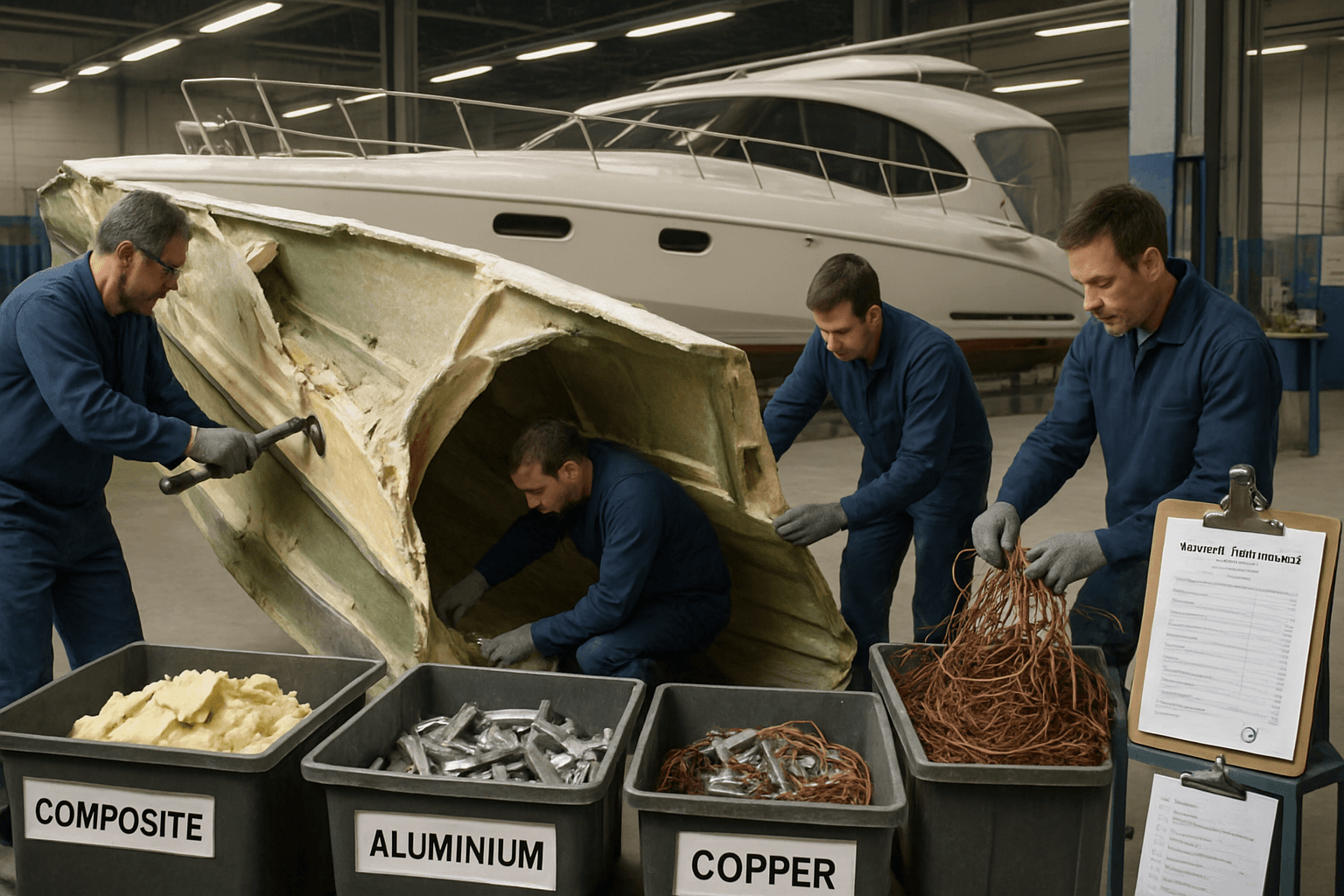
The distinction matters operationally. A vessel undergoing planned refurbishment can recover high-value composite materials, aluminium, and stainless steel before decommissioning. A vessel scrapped without selective dismantling simply forfeits that recovery value — the materials go to landfill or low-grade recycling instead of back into the supply chain.
Refurbishment Economics and Lifecycle Value
Refurbished vessels avoid repeating the most carbon-intensive phase of vessel construction: building a new hull. The precise embodied-carbon saving varies by hull material, vessel size, and the scope of the refit — operators should ask any refit yard or LCA provider for a vessel-specific figure rather than relying on an industry average. The manufacturing phase is carbon-intensive enough that avoiding it is significant regardless of the exact percentage in any given case.
Material reuse economics depend on supply chain infrastructure. Composite recycling remains fragmented across EU ports; established recovery networks exist in Northern Europe (Netherlands, Germany, Denmark) but are sparse in Mediterranean and Balkan regions. Operators planning refurbishment must audit local dismantling and material recovery capacity before committing to refit timelines and budgets.
Aluminium and stainless steel recovery is mature and economically viable. Secondary aluminium carries approximately 95% lower embodied energy than primary production. For charter operators and management companies, this creates a defensible ESG narrative: refurbished vessels with recovered materials demonstrate measurable lifecycle advantage over new builds, auditable through third-party LCA certification.
Governance and Audit Requirements
Refurbishment decisions now require documented material flow tracking. Classification societies increasingly expect vessel owners to declare material composition and recovery pathways as part of class renewal and ESG audits. Lloyd's Register and DNV publish guidance specifically on the EU Ship Recycling Regulation and the Inventory of Hazardous Materials it requires — the real regulatory anchor behind these declarations, not a generic circular-economy framework.
Owners should establish material inventory records at refit: what composite, metal, and systems are being removed, where they are being recovered, and what certifications the recovery facility holds. This documentation becomes material to ESG reporting, guest disclosure, and regulatory defence if waste classification questions arise.
Market Intelligence: Regional Capacity and Timing
Composite recycling capacity in the Mediterranean remains constrained. Most selective dismantling occurs in Northern Europe, creating logistics costs and carbon debt from transport. Operators planning refurbishment in 2026–2027 should map recovery partners now; securing certified facilities late can meaningfully extend a refit schedule, so this belongs in early planning, not as a late-stage logistics detail.
HVO and other sustainable fuels reduce operational emissions but do not address embodied carbon in hull and systems. Refurbishment with material recovery addresses the full lifecycle footprint, making it strategically complementary to fuel switching, not a substitute.
What Operators Should Monitor
Watch for tightening enforcement of the EU Ship Recycling Regulation and growing expectations around Inventory of Hazardous Materials documentation — enforcement of existing rules is the more immediate signal here than new rulemaking. Port state control inspections increasingly scrutinise vessel waste management plans and material recovery documentation. Charter operators should audit refurbishment partners' waste certifications and recovery contracts before committing to refit schedules. Material recovery value will likely increase as EU waste pricing mechanisms tighten; early refurbishment captures higher recovery margins.